
Transparency Blocked? New Trinidad Council Member Pushes for Accountability as Questions Continue to Grow at City Hall
By TruthOutlaw
TRINIDAD, Texas — Less than a month after being appointed to the Trinidad City Council, Council Member Steven Strearman has quickly become one of the leading voices calling for transparency and accountability inside Trinidad City Hall.
Since taking office, Strearman has publicly released emails, draft agenda documents, attorney correspondence, and written statements that he says reveal a continuing pattern of delayed public records, blocked agenda items, incomplete financial oversight, and administrative failures.
According to Strearman, this isn't about personalities.
It isn't about politics.
It's about whether the citizens of Trinidad have a government that operates openly, follows the law, and remains accountable to the people it serves.
"I didn't come here to make friends. I didn't come here to protect anyone. I didn't come here to play politics. I came here to ask questions, demand accountability, and make sure our city government follows the law."
A Pattern of Delays
Strearman says nearly every attempt he has made to obtain information since joining the council has encountered another obstacle.
Whether requesting public records, asking questions about city finances, or submitting agenda items for discussion, he says there has consistently been another explanation for why information could not be provided or why issues could not be discussed publicly.
Initially, Strearman says he believed everyone inside City Hall shared the same goal of serving the public.
Over time, however, he says he came to believe transparency was no longer the priority.
Public Records at the Center of the Dispute
One issue became a turning point.
According to Strearman, he was repeatedly informed that requested public records could not be released because they were allegedly connected to pending litigation.
Rather than accept that explanation, he contacted the city's outside litigation attorney directly.
According to correspondence released by Strearman, attorney David Iglesias responded in writing that the requested records were not related to the litigation his office was handling and had been returned to the City for processing.
Despite that response, Strearman says the records still were not released.
He believes citizens deserve to know why records remained unavailable after the city's own outside attorney indicated they were unrelated to the litigation.
Working to Keep the City in Compliance
Strearman says one of his priorities since joining the council has been helping ensure Trinidad complies with the Texas Public Information Act.
Texas law establishes strict deadlines for governmental bodies responding to public information requests. Those deadlines exist to protect the public's right to know how its government operates. If a governmental body seeks to withhold information, the Act requires specific procedures and timelines for requesting a decision from the Texas Attorney General.
According to Strearman, he has worked to identify outstanding requests, communicate with city staff, and push for timely responses so the city remains in compliance with state law.
He says those efforts are not about creating conflict but about protecting both the city and its citizens by ensuring transparency requirements are followed.
Agenda Items Removed
Another issue further increased Strearman's concerns.
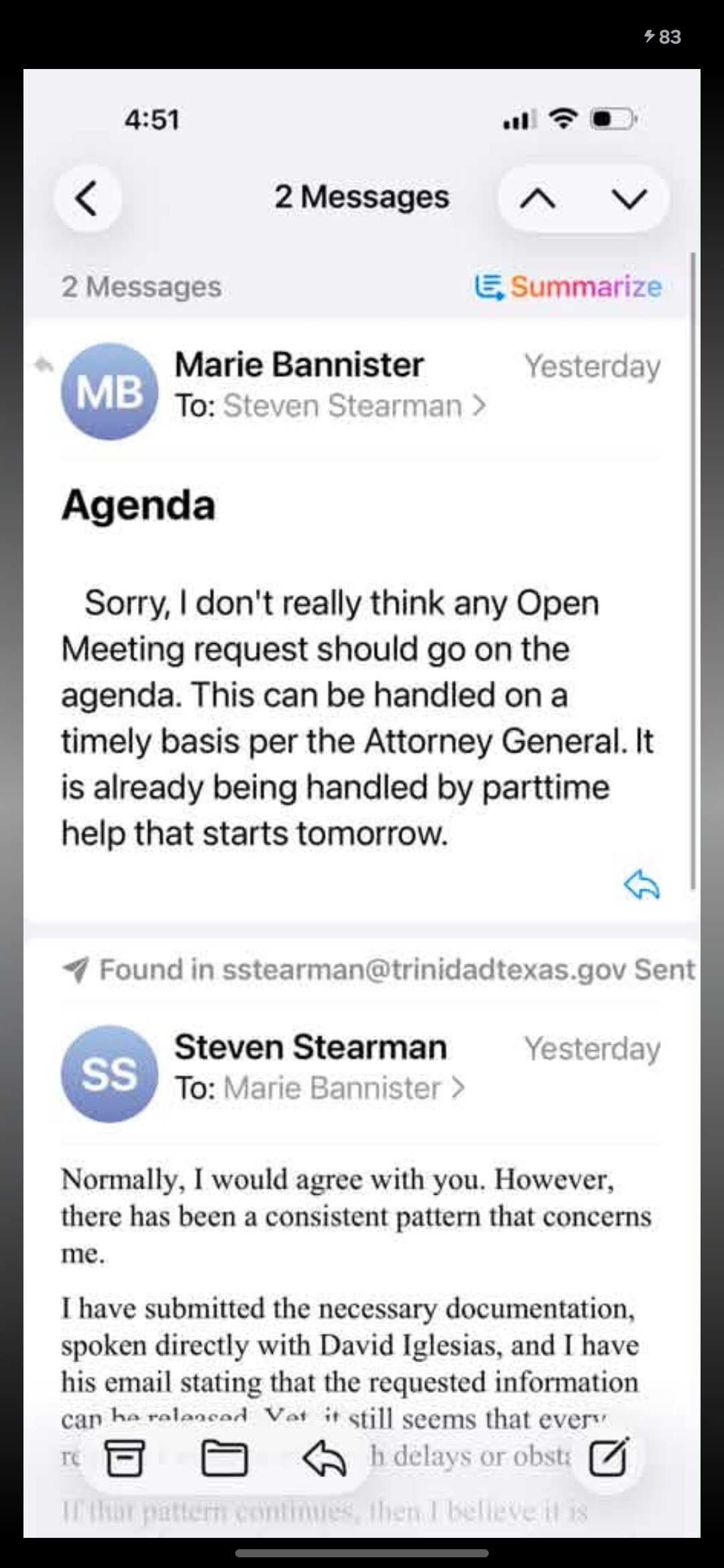
Emails released by the council member show that one of his proposed agenda items concerning public information requests was challenged before the agenda was finalized.
Council Member Marie Bannister expressed the opinion that the issue could be handled administratively rather than through discussion during a public council meeting.
Strearman disagreed.
He explained that the item provided factual background supporting another agenda item and believed both the City Council and the public deserved to hear the discussion.
According to Strearman, the agenda item was ultimately removed.
He believes government business should be debated during open meetings—not through private conversations before citizens ever have the opportunity to hear the discussion.
Financial Questions Continue
The transparency debate comes as Trinidad continues to face broader questions regarding its financial management.
Council meetings over recent months have included discussions regarding expenditures made before council approval, delayed audits, and the city's lack of an adopted operating budget during portions of this period.
Those concerns have led many residents to question how taxpayer money has been managed and whether sufficient financial oversight has existed.
The Audit Still Isn't Complete
Another issue Strearman says demonstrates deeper administrative problems is the city's long-overdue audit.
According to Strearman, he worked directly with City Administrator Cynthia Dosier to determine exactly what documentation auditors needed to complete the audit.
He says he personally completed or organized approximately 70 percent of the work necessary to move the audit forward despite serving only as a newly appointed council member rather than the city's administrator.
According to Strearman, the remaining delays are not due to missing information but to administrative failures in completing the work necessary to finalize the audit.
He argues that taxpayers deserve a complete accounting of the city's finances and that the City Council cannot effectively oversee public funds without a completed audit.
Questions About City Hall Operations
Questions about daily operations inside City Hall have also continued to surface.
When FOX 4 visited Trinidad City Hall seeking comment after the Texas Rangers confirmed they were conducting an investigation involving the City of Trinidad, City Administrator Cynthia Dosier was observed working at the water clerk's desk while the water clerk stood nearby.
That observation prompted additional public discussion.
Residents have questioned why the city administrator appeared to be performing duties assigned to another position while major administrative responsibilities—including the completion of the city's overdue audit and outstanding public records matters—remain unresolved.
Strearman believes those observations reflect broader management issues within City Hall.
A City Without Legal Counsel
These events are unfolding while the City of Trinidad is operating without a city attorney.
The City Council previously voted to terminate the city's legal counsel.
That action was followed by one of the most controversial council meetings in recent city history.
During that same meeting, the council also voted to terminate Municipal Judge Shellena Bivens.
The decision immediately generated public concern regarding judicial independence and the relationship between the governing body and the municipal court.
The Removal of the Municipal Judge
During the council meeting preceding Judge Bivens' removal, Council Member Leah Melton publicly questioned whether Judge Bivens had the authority to dismiss the disorderly conduct citation issued to local activist Otto "The Watchdog."
Otto had previously been detained in handcuffs for approximately one hour after appearing at City Hall carrying a sign reading "F* Bad Cops"** on one side and "Back the Blue" on the other.
Judge Bivens later dismissed the citation.
Following her removal, Judge Bivens sought temporary reinstatement through the courts.
During that hearing, testimony from Council Member Marie Bannister generated additional public discussion regarding the reasons behind the judge's removal.
The testimony has prompted ongoing questions from residents, including whether Judge Bivens was removed because of decisions she made while performing her judicial duties and whether a governing body should have influence over a judge's decisions to dismiss citations or criminal cases.
Those questions continue to be debated publicly.
A Call for New Administrative Leadership
Taken together, Strearman says these events have led him to one conclusion.
He no longer has confidence in the current administration of Trinidad City Hall.
He believes the City Council should objectively evaluate whether the city's administrative responsibilities are being fulfilled and, if necessary, appoint new administrative leadership capable of restoring transparency, completing overdue financial obligations, complying with state law, and rebuilding public trust.
He has also advocated for hiring an independent engineering firm to conduct a comprehensive assessment of Trinidad's water infrastructure before pursuing additional grants, arguing that the city should determine its long-term needs before seeking funding.
All Eyes on July 21
The next Trinidad City Council meeting is scheduled for July 21, and public interest is expected to be high.
With questions surrounding public records, the overdue audit, city finances, city administration, judicial independence, and the ongoing Texas Rangers investigation, many residents are expected to attend or follow the meeting closely.
Strearman has indicated that he intends to continue presenting information to both the council and the public, and many citizens are anticipating further discussion of the issues that have dominated recent meetings.
Whether the meeting brings long-awaited answers, additional questions, or significant action by the City Council remains to be seen.
One thing appears certain: Trinidad residents are paying attention.
Transparency Belongs to the People
For a council member who has served only a short time, Steven Strearman has already brought significant public attention to issues that many residents believe have existed for years.
Whether addressing delayed public records, pushing to complete the city's overdue audit, questioning administrative practices, or advocating for greater transparency, Strearman says he intends to continue keeping citizens informed.
As debate continues inside Trinidad City Hall, many residents believe the city stands at an important crossroads.
The questions now extend beyond individual disagreements.
They concern whether Trinidad's government is operating openly, complying with state law, properly managing taxpayer resources, and maintaining the public's trust.
As Strearman wrote in his public statement:
"Transparency belongs to the people—not behind closed doors."
Editor's Note: This article reports on Council Member Steven Strearman's public statements, released documents, and other publicly discussed events. Statements regarding motives, responsibility, and conclusions are attributed to those making them or presented as questions being publicly raised. Individuals mentioned may dispute these characterizations or offer different perspectives.